Originally written on 9 August 2024
This was the very first article I ever wrote for the FeenTier blog.
It began with an impulse, a mystery and a considerable amount of frustration.
The first version was kindly deleted in its entirety by the text editor when I tried to revise it.
Thank you very much for that.
Apparently, this was my opportunity to practise remaining calm, determined and unstoppable.
The article was going to be finished anyway.
The only advantage for you was that the second version became considerably shorter than the first.
What Happened to Frieda?
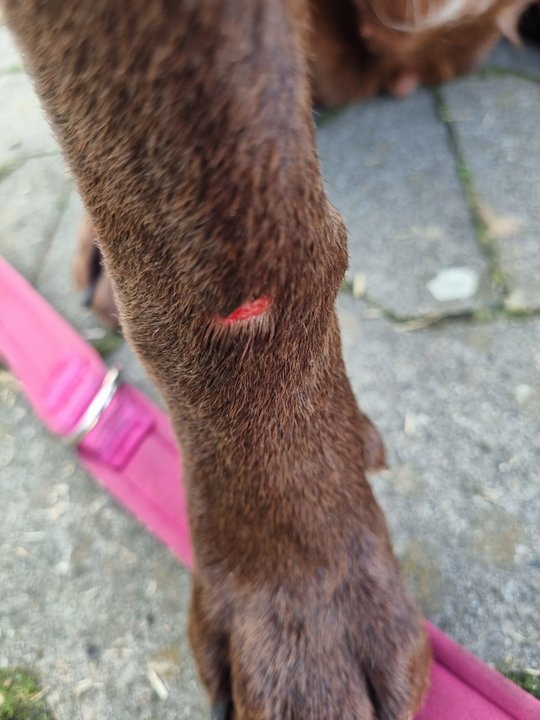
The photograph accompanying the original article showed the right front leg of my dog Frieda.
We had spent only about ten minutes together in a meadow—the same meadow where my horse Parsival was being attacked by similar creatures almost every day.
Afterwards, Frieda had several small, bloody wounds on her leg.
At that time, we had already been dealing with these mysterious bites for approximately a week and a half.
I had not yet been able to identify exactly which insect was responsible.
One possibility I found during my research was the stable fly, also known in German as a Wadenstecher or calf-biter. These flies can cause painful wounds, but I could not be certain that this was the insect we were dealing with.
For that reason, I gave our unidentified attacker its own name:
the sabre-toothed fly.
Attacked While Running and Playing
What surprised me most was that Frieda did not seem to notice that she was being bitten.
She had been running around and playing.
The insects apparently landed while she was moving, held on and did their work without causing an immediate visible reaction.
Some biting insects do not simply pierce the skin in the way a mosquito does. They use mouthparts that cut or tear the skin before feeding.
Whether the insect attacking Frieda and Parsival also released a substance that reduced the immediate sensation, I did not know.
I only knew that Frieda had apparently remained completely unaware of the attack while it was happening.
The Same Problem with My Horse
We had already experienced something similar with Parsival the previous summer.
Since then, I had tried a remarkable collection of products and mixtures:
- commercial fly sprays,
- various essential-oil blends,
- oils and other additives,
- sulphur-based preparations,
- and several homemade experiments.
None had reliably prevented these insects from attacking.
That was particularly difficult because they targeted the areas of Parsival’s body that remained exposed between his fly rug and his fly boots.
The inside and outside of the hind legs were especially vulnerable.
Covering the entire horse was one option, but I continued searching for something that might help without wrapping him completely from head to hoof throughout the summer.
What Had Helped So Far
Although I had not yet found a practical way to prevent the attacks, a few things had at least provided some protection.
Cod-Liver-Oil and Zinc Ointment
Covering the affected skin with a thick cod-liver-oil and zinc ointment helped.
The problem was practicality.
Applying a heavy ointment over a large area of a horse’s body is not particularly convenient, especially when it needs to be repeated regularly.
Clay Paste
Covering the legs with a layer of clay paste also appeared to help—as long as the clay remained in place.
Unfortunately, a horse can rub much of it off.
Once the paste dries, parts of it may also crack and fall away.
It therefore created a temporary barrier, but not necessarily a reliable one for an entire day.
Fly Rugs and Fly Boots
Physical covering remained the most dependable form of protection.
A fly rug and fly boots reduced the amount of accessible skin, but there were still gaps between them.
And the sabre-toothed flies seemed perfectly capable of finding those gaps.
My Next Experiment: Ballistol
The day before writing the original article, I had another idea.
Perhaps Ballistol sprayed onto the hair could make it more difficult for the insects to land, hold on or use their cutting mouthparts effectively.
I therefore applied it to the inner and outer areas of Parsival’s hind legs—the places left uncovered between his fly rug and fly boots.
When I wrote the article, I had not yet been back to the stable to see whether it had made any difference.
So there was no triumphant conclusion.
No miraculous solution.
Only another carefully observed experiment in progress.
Update from Summer 2026: They Are Back
Almost two years after I wrote the original article, the mysterious “sabre-toothed flies” returned.
They appeared again about a week ago, shortly after the surrounding meadows had been cut and the hay had been harvested.
Parsival was outside without his fly rug for once. During that time, he developed one more noticeable affected area as well as a few smaller marks.
As soon as he began wearing his fly rug again, the problem stopped.
His neighbouring horse, however, had already been badly troubled by the insects for several weeks. He has since been moved to a different meadow.
This has once again confirmed something that already seemed likely in 2024:
For Parsival, physical protection through a fly rug remains the most reliable solution.
Could the Horse’s Individual Scent Play a Role?
While observing the horses, another question occurred to me.
Why do some horses appear to be attacked much more severely than others, even when they are living under similar conditions?
Could an individual horse’s scent make a difference?
And could that scent be influenced by nutrition, digestion, metabolism or the condition of the skin?
I do not have a scientific answer to this question.
But I have noticed a considerable change in Parsival.
In 2024, I began to reorganise his feeding completely and to support his digestive system over an extended period. Since then, his entire physical condition has changed.
He is now leaner, appears stronger and healthier, and, in my eyes, has never looked better.
This year, we have also had comparatively few problems with insect bites overall.
The digestive system and the immune system are closely connected, but this personal observation does not prove that the change in feeding is the reason Parsival is now less affected.
Many other factors may also be involved:
- the weather,
- the insect population,
- the location of the meadow,
- the condition of the coat and skin,
- the horse’s individual scent,
- the fly rug,
- and changes in general health.
Still, I find the question worth pursuing.
Perhaps the insects are not equally attracted to every horse.
Perhaps an animal’s scent or skin environment changes when its nutrition, digestion or metabolism changes.
Or perhaps Parsival has simply been better protected this year.
At this stage, I can only observe, compare and continue asking questions.
What I Know So Far
After two summers of observation, my current conclusion is:
- The insects have returned.
- Exposed areas may still be attacked quickly.
- Parsival’s fly rug has once again stopped the immediate problem.
- Other horses nearby appear to be affected more severely.
- Parsival’s general condition has changed significantly since his feeding was reorganised.
- Whether nutrition, digestion or individual scent influences the insects’ choice remains an open question.
So this story is not finished.
To be continued.…
Why Write About What Did Not Work?
I did not write this article because I had already found the perfect answer.
I wrote it partly because I hoped someone else might recognise the wounds or identify the insect.
But I also wrote it for another reason.
When we search for solutions, we usually find people reporting what supposedly worked.
We hear much less about everything they tried before that.
And yet unsuccessful experiments can also be useful information.
When someone else has already tested several sprays, mixtures and remedies without success, that knowledge may save another animal owner time, money and frustration.
Sometimes sharing what did not work is also a contribution.
It may prevent someone else from repeating every step of the same long and expensive journey.
Can You Identify Our Sabre-Toothed Fly?
Perhaps you have seen similar wounds on your horse or dog.
Perhaps you know an insect that can land on a moving animal, cut the skin and feed without the animal reacting immediately.
Perhaps you have discovered an effective and animal-friendly way to keep these creatures away from horses during the summer.
Local conditions matter.
An approach that helps in one country, climate or landscape may not work in another.
Even so, an idea from another horse owner can open a new door.
That is one of the reasons I now share some of my experiences in English as well.
Knowledge should not stop at national or linguistic borders.
So, should you have any useful clues concerning our mysterious sabre-toothed flies, I would be very happy to hear from you.
Until then, I will continue observing, researching and trying to remain calm, determined and unstoppable.
With love,
Anke
Schreibe einen Kommentar