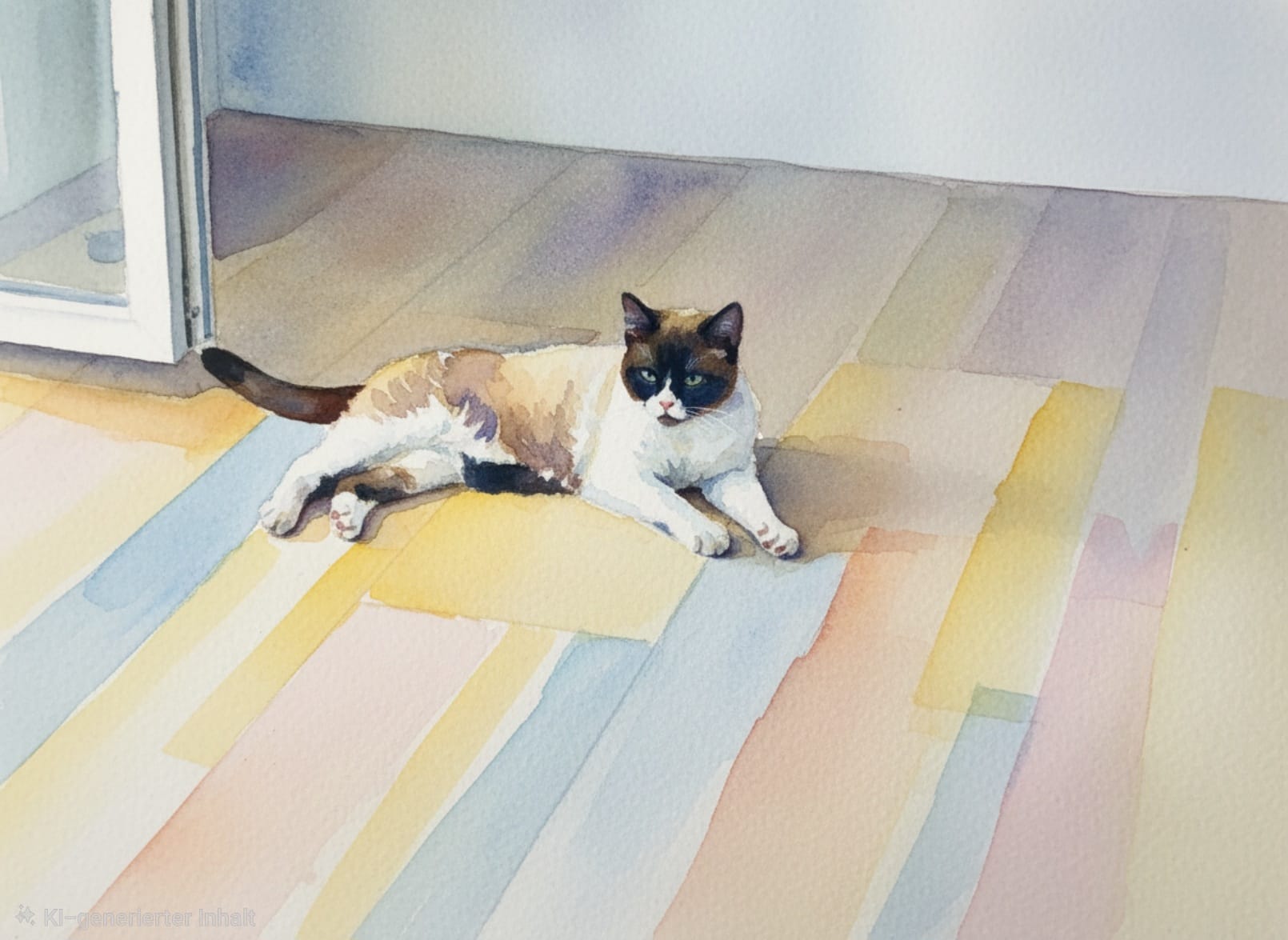
A Happy Ending, Animal Communication and a Subject I Had Avoided for a Long Time
On Saturday morning, shortly before 9 a.m., I received a message from a neighbour.
She asked whether I had seen her cat.
He had last been home the previous morning and had not returned during the day or evening. This was completely unusual for him.
At first, I had to tell her that I had not seen him.
A few hours later, I met my neighbour while she was already searching the surrounding area. We talked about what had happened in the days before his disappearance and whether there might be any indication of why he had not come home.
She told me that the cat had brought home a rat a few days earlier.
Because he had apparently been able to catch it quite easily, she was worried that the rat might have been weak or possibly poisoned.
Of course, it was impossible to determine from the situation whether this had anything to do with his disappearance.
We discussed the fact that poisoning can develop very differently depending on the substance and the amount consumed. At the same time, it did not seem like the most obvious explanation for why the cat had suddenly failed to return home several days later.
I hoped I could at least relieve some of her worry about this possibility.
Missing Animals Create an Exceptional Situation
Searching for missing animals is a subject I have tended to avoid.
Not because animal communication cannot play a role in such situations.
Quite the opposite.
During several training programmes, I learned how to connect with a missing animal, gather impressions and receive possible information about its surroundings.
However, the emotional responsibility involved is considerable.
When a beloved animal disappears, the owner enters an exceptional emotional situation.
Thoughts begin to circle.
Worry grows.
Every sound can suddenly create either hope or fear.
There can also be many different reasons why an animal does not return home.
An animal may be injured or unwell.
It may accidentally have been locked inside a garage, basement, shed or garden building.
It may have been frightened and gone into hiding.
A loud sound, an unfamiliar animal or an unusual situation may have caused it to leave its familiar territory.
And sometimes a cat simply finds another place that currently seems especially attractive.
I experienced this myself when I was younger. Our cat temporarily found a second home with an older woman who apparently provided a particularly persuasive selection of delicacies.
A missing cat is therefore not automatically in danger.
Nevertheless, a practical search should begin quickly and thoroughly.
Practical Searching and Animal Communication Belong Together
I offered to help my neighbour if the cat had still not returned by the following day.
I asked her to send me a photograph so that I could share it with our animal communication group.
Several members of the group have already learned how to connect with animals and how to examine their perceptions carefully and responsibly.
Alternatively, we could have worked with the case together during our practice group on Wednesday.
It was important to me that animal communication should never replace the practical search.
I therefore also sent her information from TASSO and FINDEFIX, two German pet registration and missing-animal services. They provide clear guidance on how to report a missing animal and which practical search measures may be helpful.
These can include:
- informing neighbours,
- asking people to check garages, basements, sheds and garden buildings,
- contacting local veterinarians, shelters and official animal-finding services,
- registering the animal as missing,
- repeatedly searching the immediate area, particularly during quieter hours,
- and making as many people as possible aware of the situation.
Animal communication may offer additional impulses.
But it should always be combined with an active search in the physical world.
Which Information Can Be Helpful?
On my way home from the stable, I received a message at 5:21 p.m. containing several photographs of the cat.
My neighbour asked what further information I would need.
I replied that a photograph showing his face clearly, and ideally one of his eyes, would be helpful.
For animal communication, the background to the disappearance, the last confirmed location and any recent changes in the animal’s environment may also be relevant.
Unusual events during the previous days may be worth mentioning as well.
Not because every detail necessarily contains the answer, but because it may provide meaningful areas to explore during the connection with the animal.
The exact process, the specific questions and the responsible interpretation of such perceptions belong, in my view, within a protected training environment.
Particularly when an animal is missing, it is not enough to ask random questions and immediately treat every inner image as a fact.
This work requires experience, neutrality and a responsible approach to the hopes and fears of the animal’s owner.
Creating an Inner Path Home
At 5:26 p.m., I sent my neighbour a voice message that lasted approximately one and a half minutes.
I explained which information she could prepare so that I could then pass the complete story directly to our group.
At the end of the message, I gave her one more impulse.
I invited her to imagine as vividly as possible how her cat would return home.
Not the fear.
Not the images of what might have happened to him.
But the path back.
How he would cross the meadow.
How he would approach the terrace.
How he would come through the door.
How he would be home again.
Creating such an inner image may help the owner step away from fear for a moment and reconnect with the bond to the animal and the possibility of a safe return.
At the same time, I connected with the cat myself.
Because I knew him personally, I did not need a photograph.
I made contact with him inwardly and asked him to return home.
I also imagined him finding his way back and arriving safely with his family.
And Then the Message Arrived
At 5:26 p.m., I had sent my neighbour the voice message and invited her to imagine her cat returning home.
While she listened to it, I connected with him and asked him inwardly to come back.
At 5:32 p.m., her message arrived:
The cat is back in the living room.
Only a few minutes had passed between my voice message and his return.
It was precisely this synchronous timing that felt so remarkable to both of us.
Of course, it is not proof that the animal communication or our inner focus caused him to return.
But it is a striking indication.
Perhaps he was already on his way home.
Perhaps he perceived our images, our invitation or the clear inner focus of his owner.
Perhaps several things came together at exactly the same time.
I do not know.
But within this narrow space between coincidence, connection and possible influence, something happened that touched us both deeply.
Was It the Animal Communication?
I cannot prove what caused the cat to come home at that exact moment.
Perhaps he would have returned at 5:32 p.m. regardless.
Perhaps he had been nearby all along.
Perhaps he was already walking towards the house while we were speaking.
Perhaps the clear inner focus of his owner changed something.
Perhaps he perceived her images, our invitation or my request.
I do not know.
That is precisely why I believe it is important neither to dismiss such experiences nor to turn them too quickly into claims of certainty.
What I can say is this:
The timing was remarkable.
Both of us had focused very clearly on his safe return.
And only minutes later, he was back in the living room.
For me, this was a moving reminder that animal communication is not only about receiving information from an animal.
It can also mean consciously creating contact.
Offering an invitation.
Sending a familiar inner image.
And communicating to the animal:
You are being searched for. You are loved. You are allowed to come home.
Why the Animal’s Owner Should Be Actively Involved
When an animal is missing, I believe it is especially important not to turn the owner into a passive recipient of statements made by someone else.
The owner knows the animal, its habits, its surroundings and the places where it may choose to hide.
The owner can search.
They can speak to neighbours.
They can ask people to check doors, sheds, garages and basements.
They can notify official services.
And they can remain inwardly connected to their animal.
Animal communication should strengthen people.
It may help them move from complete helplessness back into meaningful action.
Positive communication is especially important to me.
Instead of repeatedly sending the animal images of fear, danger and despair, we can focus on connection, orientation and a safe return.
The specific questions, the way perceptions are assessed and the distinction between our own inner images and possible information from the animal are part of a thorough animal communication training.
Perceptions should initially be treated as indications.
They are not guaranteed locations and should never be communicated uncritically as facts.
Why I Prefer Working in a Group
When animals are missing, I personally prefer working with several people.
This is not because one experienced animal communicator cannot receive valuable information.
But even experienced people may unintentionally bring their own images, hopes, fears or interpretations into the communication.
When several people independently receive similar impressions, a different quality can emerge.
Repeated similarities may strengthen a possible indication and offer the owner a direction for the practical search.
Even then, an agreement between several people is not proof.
It may provide orientation, but it must still be compared with the real circumstances on site.
Other methods may also be included alongside telepathic communication.
Which methods are appropriate, and how they can be used responsibly, also belong within a supported learning and training environment.
In an emotionally exceptional situation, the method alone is not what matters.
Clarity, grounding and a careful approach to the person waiting for news of their animal are equally important.
A Subject I Am Now Ready to Face
This happy ending showed me something else.
Until now, I have not placed the subject of missing animals at the centre of my work.
The emotional responsibility is significant.
Not every case ends as quickly or happily as this one.
Not every perception is clear.
And no one should make promises to a desperate animal owner that cannot be kept.
At the same time, this cat made me realise that I should not completely withdraw from the subject.
I do not need to actively seek these cases.
But when one is brought to me, I can pause and consider whether it may be part of my task in that particular moment.
Perhaps then I can make a contribution.
For the animal.
For the person.
For the search.
And sometimes, perhaps, for the journey home.
This experience will therefore also become part of my animal communication training.
The subject of missing animals will receive its own place there in the future: responsible, practical, grounded and at the same time open to the possibilities of telepathic connection.
Because on that Saturday, a cat came home.
And with him, a subject returned to me that I no longer wish to avoid.
With love,
Anke
Schreibe einen Kommentar