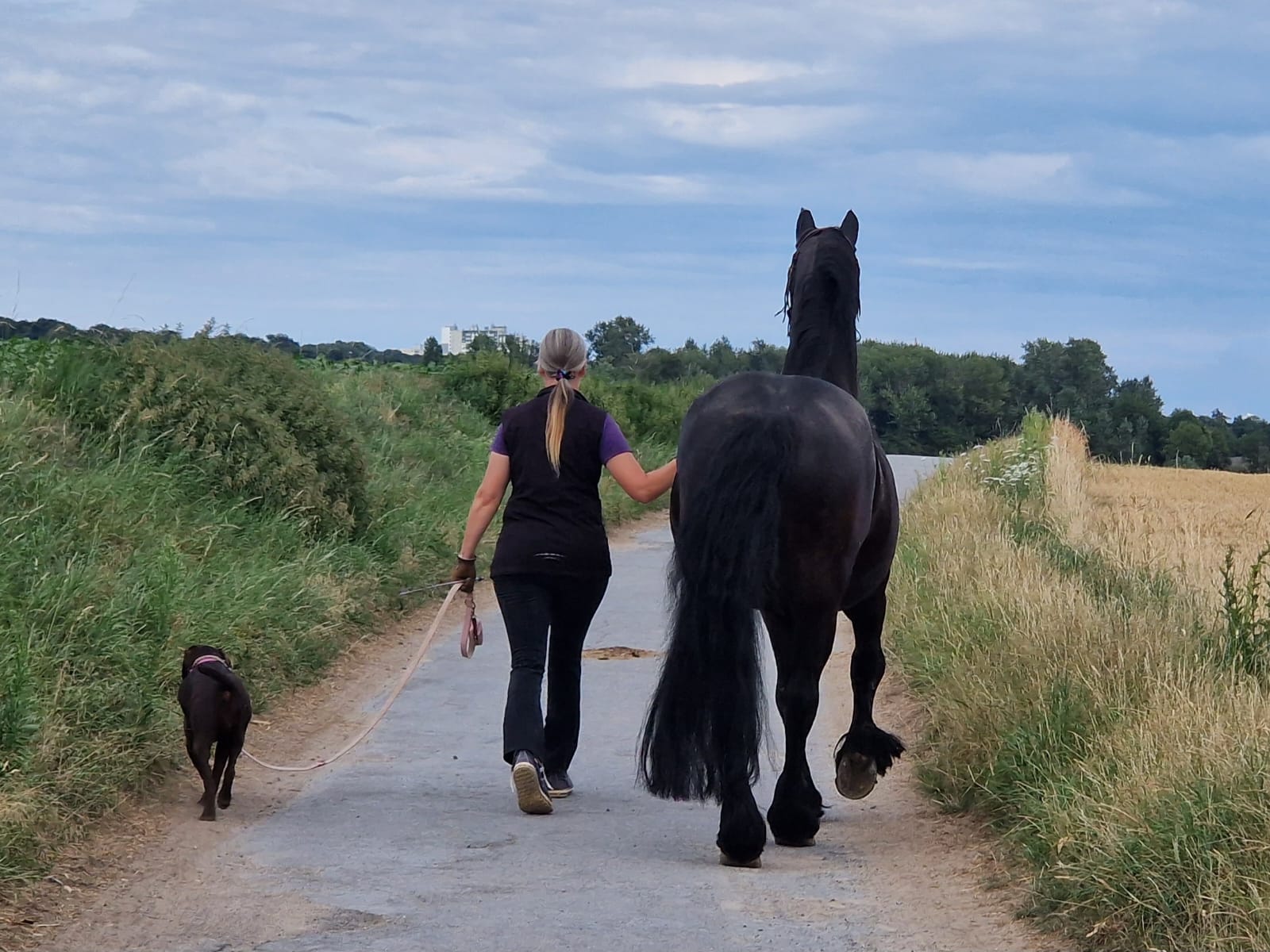
Why I Have Always Felt More at Home with Animals
I spent much of my childhood in stables and surrounded by animals.
With them, I felt safe.
I felt understood.
I felt at home.
Animals are truthful, honest and immediate. What they express through their bodies, their energy, their behaviour and their presence is usually genuine.
With people, I often experienced something different.
Words, facial expressions, emotions and true intentions do not always match. People may smile while feeling angry. They may say something kind while pursuing a very different goal. They may hide what they really think or try to influence others without speaking openly.
Even as a child, I found this difficult.
I have always preferred truthfulness, honesty and authentic behaviour. I find it deeply unsettling when someone pretends that everything is fine while something entirely different can be felt beneath the surface.
For a long time, I did not fully understand why this affected me so strongly.
Today, I know that one reason is my high sensitivity.
What Does It Mean to Be Highly Sensitive?
Highly sensitive people are often described as perceiving and processing more information than others.
We may hear more.
We may feel more.
We notice subtle changes in atmosphere, tone of voice, facial expression, body language and energy. We often sense what is happening beneath the spoken words.
This can be both a burden and a gift.
A sensitivity to sound can sometimes be managed with headphones, silence or conscious redirection.
But what about emotional sensitivity?
What do you do when you enter a room and immediately feel tension, anger or aggression before anyone has said a word?
What do you do when another person’s emotions cause your stomach to contract, your body to tense or nausea to arise?
And is there really such a thing as being too sensitive?
Too sensitive compared to whom?
For many years, the easiest solution seemed to be wearing an invisible suit of armour.
To appear distant.
To become difficult to reach.
To protect myself by seeming unapproachable.
That armour helped me survive situations in which I did not yet know how to distinguish between my own emotions and those I was perceiving from others.
But armour also keeps out the beautiful things.
Connection.
Warmth.
Trust.
Intimacy.
And the very sensitivity that once felt overwhelming would later become one of my greatest strengths.
Perhaps You Recognise Yourself Here
Perhaps you enter a room and immediately know that something is wrong.
Perhaps you feel another person’s sadness before they admit it to themselves.
Perhaps noise, conflict, artificial friendliness or crowded places exhaust you more than they seem to exhaust other people.
Perhaps you have spent years hearing that you are too emotional, too sensitive or too easily affected.
Perhaps you have tried to become tougher.
Less open.
Less perceptive.
Less yourself.
When you recognise yourself in these words, welcome to my world.
You are not alone.
Over the years, I have learned that sensitivity does not have to remain an uncontrolled flood of impressions. We can learn to understand it, to set boundaries and to distinguish what belongs to us from what we are perceiving from someone else.
Sensitivity can become a conscious ability.
It can become orientation.
And sometimes, it can become a gift.
My Sensitivity Became a Strength with Animals
In my work and life with animals, my sensitivity has always played an important role.
I often perceive slight discomfort before an animal expresses it through obvious behaviour.
I may notice that a new object, movement, treatment or situation does not feel right for a horse before the horse pins its ears, moves away or shows a clearly visible reaction.
Sometimes I become aware that an animal is in pain or physically uncomfortable before there is an obvious external sign.
Of course, perception is not the same as diagnosis.
But perception can be the beginning of a question.
It can make us look more closely.
It can encourage us to observe, investigate and seek professional support sooner.
One of the most important things I have learned is how to distinguish between my own feelings and those of an animal.
Is this tension mine?
Did I already feel this before I approached the animal?
Does the sensation change when I move away?
Does it return when I reconnect?
This kind of discernment takes practice, honesty and neutrality.
Sensitivity alone is not enough.
We also need grounding, knowledge and the willingness to question our first interpretation.
Feeling with the Hands
My sensitivity also extends to touch.
With my hands, I perceive differences in skin, fascia, tissue, temperature, tension and swelling.
Some of this can be learned and trained.
But I also believe that people begin from different levels of tactile perception.
During my training as a holistic therapist for horses and dogs, including osteopathic, physiotherapeutic and acupuncture-based approaches, I learned the anatomical and structural knowledge necessary to understand what I was touching and where different connections might lead.
For me, it was often relatively easy to find the area that seemed to be causing the most obvious restriction.
But the body is not made of isolated parts.
Everything is connected.
Through the fascia, tension in one area can affect many others. When the loudest or most obvious problem has been addressed, another layer may become visible.
We sometimes describe this as peeling an onion.
Layer by layer, the body reveals what is ready to be seen.
The idea of fascial intelligence continues to fascinate me. Particularly in rehabilitation and supportive bodywork, much may become possible when we stop treating fascia as passive wrapping and begin to recognise its role within the whole living system.
My Path Continued
When I first wrote about my high sensitivity, my path had already taken me through many years of learning.
But it did not stop there.
Since then, I have continued to study, research, experience and expand my work.
Alongside energetic methods, I completed further training in Organetik and bioresonance-based work for humans and animals.
I also trained in Organo Feng Shui, exploring how rooms, places, environmental influences and energetic structures may affect wellbeing.
My work has increasingly brought together different worlds:
the visible and the subtle,
the physical and the energetic,
the analytical and the intuitive,
the individual being and the space surrounding them.
I work with people and animals, with bodies, emotions, energetic patterns and environments.
I continue to explore what may support balance, regulation and the body’s own capacities.
And since this year, I have also been training other people.
This has opened another important part of my path.
It is one thing to perceive, experience and apply something yourself.
It is another to help someone else trust their own perception without imposing your own interpretations upon them.
Teaching requires clarity.
It requires responsibility.
It requires the ability to explain subtle processes in understandable language.
And it requires the humility to remind people that their own experience matters.
I do not want to create copies of myself.
I want to help people recognise and develop their own way of perceiving.
Analytical Mind and Trained Intuition
In another part of my professional life, I am a lawyer.
At first glance, legal work and intuitive work may seem like opposites.
For me, they are not.
My legal training taught me to analyse complex situations, distinguish facts from assumptions, recognise contradictions, ask precise questions and avoid accepting the first simple explanation.
My intuitive work taught me to listen beyond what is immediately visible.
Together, they have become an unusually valuable partnership.
An analytically trained mind and a carefully developed intuition can be a dream team.
The mind provides structure.
Intuition notices what has not yet been put into words.
Knowledge creates safety.
Perception opens new questions.
Neither should silence the other.
“Forget the Mind”
One of the most memorable lessons came from my horse, Parsival.
On 26 January 2017, when I placed my first acupuncture needle, I received the message:
“Forget the mind.”
The original German wording was rather more direct:
“Scheiß auf den Verstand.”
This did not mean that I should abandon knowledge, reason or responsibility.
Parsival was not asking me to stop thinking.
He was reminding me not to let my trained mind dismiss everything I could already feel.
The mind is a wonderful instrument.
But it can also be manipulated.
It can repeat old beliefs.
It can explain away a clear inner knowing.
It can demand proof before allowing us to acknowledge what our body, our intuition or an animal has already communicated.
My path has not been about choosing intuition instead of reason.
It has been about allowing both to work together.
Animals Need Our Presence
I have meditated and explored spiritual subjects since my youth.
Over time, I learned how important it is for me to return to my centre and remain present in the here and now.
A calm mind is essential in my relationship with horses.
Animals notice whether we are truly present.
They recognise tension that we try to hide.
They feel whether our outer behaviour and inner state match.
When we become quieter within ourselves, our entire presence changes.
We breathe differently.
We move differently.
We make different decisions.
Animals often feel safer around someone whose presence is clear, calm and authentic.
This does not mean that we must always be perfectly peaceful.
It means that we are honest about our state and willing to regulate ourselves rather than expecting the animal to carry what we refuse to acknowledge.
Sensitivity Is Not Weakness
For a long time, sensitivity may feel like an open wound.
We feel too much.
We hear too much.
We notice too much.
We become exhausted by what others appear to overlook.
But sensitivity can develop.
We can learn boundaries without building permanent walls.
We can learn to remain open without absorbing everything.
We can learn to ask:
Is this mine?
Does this belong to someone else?
Is this information useful?
Do I need to act?
Can I let it pass?
We can learn to trust what we perceive while remaining willing to verify, question and refine it.
Then sensitivity is no longer only something that happens to us.
It becomes something we can work with.
A compass.
A form of intelligence.
A gift.
A Contribution to Others
One of the intentions behind my work is to make my own corner of the world a little brighter, kinder and more whole.
I love the Sanskrit words:
Lokah Samastah Sukhino Bhavantu.
May all beings be happy and free, and may my thoughts, words and actions contribute to the happiness and freedom of all.
I do not believe that one person has the answer for everyone.
But I do believe that our experiences can become contributions to one another.
A story can help someone feel less alone.
A question can open a new direction.
A perception can encourage someone to look more closely.
A shared experience can become the missing piece another person has been searching for.
Perhaps my path can help another highly sensitive person stop seeing themselves as defective.
Perhaps it can help someone understand why they have always felt safer with animals.
Perhaps it can encourage someone to trust their perception while also developing discernment, knowledge and grounding.
And perhaps it can remind us that sensitivity is not something we necessarily need to remove.
Sometimes, it is something we are here to understand.
To refine.
To honour.
And eventually, to share.
With love,
Anke
Schreibe einen Kommentar