Why Your Inner State Matters More Than the Movement of the Instrument
Originally written on 9 September 2024 — updated in July 2026
On 3 September 2024, I finally brought a long-held idea to life:
I created the first course I would teach myself.
A tensor course.
At first, the working title was rather technical, something along the lines of “Radiesthesia with a Tensor”.
But on 9 September 2024, at exactly 12:45 p.m., a different name suddenly came to me:
Parsival’s Tensor Course.
The name immediately created a strong inner resonance.
Parsival is my beloved companion in the form of a Friesian horse. His name can be interpreted as “a mediator between worlds.”
In that moment, I understood what this first course was truly intended to support:
perceiving, translating and building bridges between the physical and the subtle worlds.
Between what is visible and what is not yet visible.
Between what the analytical mind can already understand and what may first appear as a feeling, an impulse, a movement or an inner knowing.
Welcome to a World of Energy and Vibration
Everything is in motion.
Bodies.
Thoughts.
Emotions.
Spaces.
Relationships.
And what some people describe as the matrix, the field, the Akashic field or an informational space.
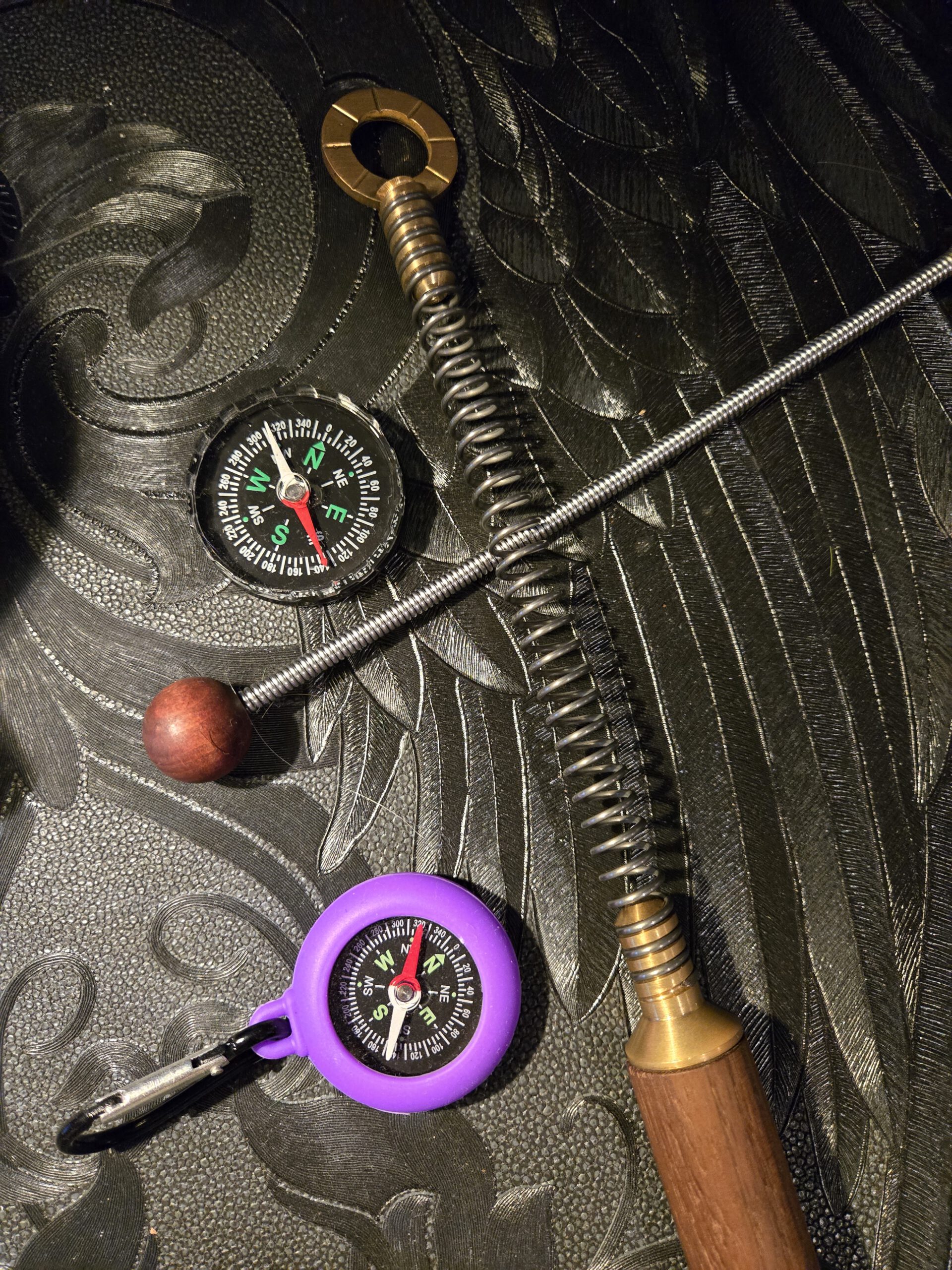
In this kind of work, a tensor can act like a translator.
It may make a fine physical or energetic response visible when we sense something but cannot yet consciously express it in words.
But today I know:
The tensor is not the one that knows the answer.
It is not an oracle.
It is not the source.
It is an instrument that can make a subtle response visible.
The essential connection arises within the person holding it.
My First Miscalculation: One Page Would Be Enough
When I wrote my original article, I believed that one page of course material would probably be sufficient.
The rest would simply be learned through practical experience.
Today, that makes me smile.
Of course, one page was not enough.
Working with a tensor or pendulum is not only about holding the instrument and observing how it moves.
It involves much more:
perception,
inner clarity,
neutrality,
trust,
coherence,
the quality of the question,
and the ability to allow an answer without determining it in advance.
The basic use of the instrument can be explained quite quickly.
The inner state behind it is the real work.
A Tensor Can Move Without Giving a Clear Answer
Many people first learn questions such as:
What does my “yes” look like?
What does my “no” look like?
Which movement appears during harmonisation?
How should I hold the instrument?
These basics are useful.
But they are not enough.
A tensor may move because the hand is restless.
Because a certain answer is expected.
Because the person is afraid of doing something incorrectly.
Because the question was unclear.
Because the mind has already decided which result should appear.
Or because the person is trying so hard not to influence the answer that the entire body becomes tense.
Something may be moving.
But the important question remains:
From which inner state did that movement arise?
Your Inner State Matters More Than the Tool
In December 2025, I had the opportunity to teach a Saturday course for people who had already attended several tensor courses.
They understood the basic movements.
They knew in theory how a yes or no might appear.
And yet they still did not feel confident.
This experience showed me once again:
The primary challenge is not reading the movement correctly.
It is whether the person is in a state in which clear perception is possible at all.
Am I calm within myself?
Am I connected to my own body?
Can I receive an answer without trying to control it?
Do I trust my perception?
Can I accept a result even when it does not match my expectations?
Am I willing to reformulate the question when no clear answer appears?
And can I accept that sometimes no answer is available yet?
These are not merely technical questions.
They are questions of mindset and inner posture.
Coherence: When the Inner System Works Together
For me, this work is deeply connected with coherence.
A state in which thoughts, emotions, body and intention are not pulling in opposite directions.
When my mind is trying to force an answer, while my body is tense and my feelings point elsewhere, there is no clear inner line.
When I become centred, quiet and open, something different can happen.
The tensor is no longer questioned anxiously.
It becomes part of a dialogue.
The mind is still welcome.
It may formulate precise questions.
It may record, examine and compare the results.
But it should not decide in advance which answer is allowed to be correct.
As I wrote in the original course material:
The mind may record the results if it wishes. But it does not need to control everything.
Meeting Your New Translator
In my first course, I wanted to introduce each participant to their new “translator”.
I still love this expression.
We create agreements.
We clarify the signals.
And then we take our first test drives together.
At the time, I deliberately chose the term “test drive” instead of “breaking in” or “first ride”. After all, the course was not only for horse owners. And almost everyone understands the excitement of a first test drive.
Today, however, I know that before we begin, another question is important:
Who is sitting behind the wheel?
The anxious mind?
Expectation?
The desire for a particular answer?
Or a calm and grounded person who is willing to perceive?
Mindset Is the Colour on the Brush
These experiences later contributed to the creation of my mindset programme, BRUTUS.
For me, mindset is the foundation of both animal communication and energetic work.
Without that foundation, we can learn techniques and hold beautiful tools in our hands.
But the result often remains pale or uncertain.
I like to compare it to a paintbrush.
You may own the finest and most beautiful brush.
But when you have only water and no colours, no picture will appear on the paper.
The tensor is the brush.
Technique teaches you how to hold and guide it.
But presence, trust, clarity and coherence are the colours.
Only then can an image emerge.
Do Not Follow Blindly — Examine Consciously
Working with a tensor does not mean treating every movement as absolute truth.
Quite the opposite.
Responsible work also includes:
asking clear questions,
checking results,
noticing contradictions,
testing again when necessary,
recognising personal wishes and expectations,
and considering practical or professional information.
A tensor does not replace a medical diagnosis, veterinary examination or professional decision.
It may offer indications.
It may expand the questions we ask.
It may help us perceive energetic connections or make an individual selection.
But the person working with the instrument remains responsible for interpreting the results appropriately.
Everyone Perceives Differently
Today, I no longer teach with the expectation that everyone should eventually test in exactly the same way.
Each person has their own form of perception.
Some feel very clearly through the body.
Others receive images.
Some perceive inner words.
Others experience a clear movement of the instrument without additional impressions.
The goal is not to copy another person’s perception.
It is to learn your own language.
A tensor can be a wonderful companion in this process.
It can help make subtle perception more visible and support growing confidence.
But in the long term, the path always leads back to yourself.
Small Groups Create Depth
My courses intentionally take place in small groups.
The number of participants is limited to a maximum of nine.
This allows every person to be seen and heard.
Every question receives space.
Everyone can practise, receive feedback and develop their own way of perceiving.
A small group creates a special quality.
People can experiment without feeling that they have to perform in front of a large audience.
They discover that uncertainty is not a failure.
They learn that clear perception does not arise through pressure.
And they experience how differently a subtle impulse may appear for different people.
It is precisely this variety that makes learning together so valuable.
What Comes Next
If there is sufficient interest, an independent tensor course may take place in October or November 2026.
In addition, working with a tensor will be part of the next training and development programme, expected to begin in mid or late January 2027.
As in the current programme, different participation periods are planned, allowing people to join for three, six, nine or twelve months.
The group will remain intentionally small.
This work does not need a large room filled with people.
It needs a protected space in which each person can learn to trust themselves.
A Bridge Between Worlds
When the name “Parsival’s Tensor Course” came to me in 2024, I had no idea how much would grow from that first course.
Today, I understand the name more deeply.
A tensor does not merely translate between yes and no.
It can become a bridge:
between body and consciousness,
between analytical thought and intuition,
between visible matter and subtle perception,
between knowledge and inner trust.
Perhaps that is part of Parsival’s role in my life.
And perhaps it is also the role of this course:
to remind people that they may be able to perceive far more than they have previously believed.
You are warmly invited into our world.
A world of energy and vibration.
With a touch of magic.
A generous amount of grounding.
And an enormous portion of unconditional love.
With love,
Anke
Parsival’s Tensor Course — A Bridge Between Worlds
Why Your Inner State Matters More Than the Movement of the Instrument
Originally written on 9 September 2024 — updated in July 2026
On 3 September 2024, I finally brought a long-held idea to life:
I created the first course I would teach myself.
A tensor course.
At first, the working title was rather technical, something along the lines of “Radiesthesia with a Tensor”.
But on 9 September 2024, at exactly 12:45 p.m., a different name suddenly came to me:
Parsival’s Tensor Course.
The name immediately created a strong inner resonance.
Parsival is my beloved companion in the form of a Friesian horse. His name can be interpreted as “a mediator between worlds.”
In that moment, I understood what this first course was truly intended to support:
perceiving, translating and building bridges between the physical and the subtle worlds.
Between what is visible and what is not yet visible.
Between what the analytical mind can already understand and what may first appear as a feeling, an impulse, a movement or an inner knowing.
Welcome to a World of Energy and Vibration
Everything is in motion.
Bodies.
Thoughts.
Emotions.
Spaces.
Relationships.
And what some people describe as the matrix, the field, the Akashic field or an informational space.
In this kind of work, a tensor can act like a translator.
It may make a fine physical or energetic response visible when we sense something but cannot yet consciously express it in words.
But today I know:
The tensor is not the one that knows the answer.
It is not an oracle.
It is not the source.
It is an instrument that can make a subtle response visible.
The essential connection arises within the person holding it.
My First Miscalculation: One Page Would Be Enough
When I wrote my original article, I believed that one page of course material would probably be sufficient.
The rest would simply be learned through practical experience.
Today, that makes me smile.
Of course, one page was not enough.
Working with a tensor or pendulum is not only about holding the instrument and observing how it moves.
It involves much more:
perception,
inner clarity,
neutrality,
trust,
coherence,
the quality of the question,
and the ability to allow an answer without determining it in advance.
The basic use of the instrument can be explained quite quickly.
The inner state behind it is the real work.
A Tensor Can Move Without Giving a Clear Answer
Many people first learn questions such as:
What does my “yes” look like?
What does my “no” look like?
Which movement appears during harmonisation?
How should I hold the instrument?
These basics are useful.
But they are not enough.
A tensor may move because the hand is restless.
Because a certain answer is expected.
Because the person is afraid of doing something incorrectly.
Because the question was unclear.
Because the mind has already decided which result should appear.
Or because the person is trying so hard not to influence the answer that the entire body becomes tense.
Something may be moving.
But the important question remains:
From which inner state did that movement arise?
Your Inner State Matters More Than the Tool
In December 2025, I had the opportunity to teach a Saturday course for people who had already attended several tensor courses.
They understood the basic movements.
They knew in theory how a yes or no might appear.
And yet they still did not feel confident.
This experience showed me once again:
The primary challenge is not reading the movement correctly.
It is whether the person is in a state in which clear perception is possible at all.
Am I calm within myself?
Am I connected to my own body?
Can I receive an answer without trying to control it?
Do I trust my perception?
Can I accept a result even when it does not match my expectations?
Am I willing to reformulate the question when no clear answer appears?
And can I accept that sometimes no answer is available yet?
These are not merely technical questions.
They are questions of mindset and inner posture.
Coherence: When the Inner System Works Together
For me, this work is deeply connected with coherence.
A state in which thoughts, emotions, body and intention are not pulling in opposite directions.
When my mind is trying to force an answer, while my body is tense and my feelings point elsewhere, there is no clear inner line.
When I become centred, quiet and open, something different can happen.
The tensor is no longer questioned anxiously.
It becomes part of a dialogue.
The mind is still welcome.
It may formulate precise questions.
It may record, examine and compare the results.
But it should not decide in advance which answer is allowed to be correct.
As I wrote in the original course material:
The mind may record the results if it wishes. But it does not need to control everything.
Meeting Your New Translator
In my first course, I wanted to introduce each participant to their new “translator”.
I still love this expression.
We create agreements.
We clarify the signals.
And then we take our first test drives together.
At the time, I deliberately chose the term “test drive” instead of “breaking in” or “first ride”. After all, the course was not only for horse owners. And almost everyone understands the excitement of a first test drive.
Today, however, I know that before we begin, another question is important:
Who is sitting behind the wheel?
The anxious mind?
Expectation?
The desire for a particular answer?
Or a calm and grounded person who is willing to perceive?
Mindset Is the Colour on the Brush
These experiences later contributed to the creation of my mindset programme, BRUTUS.
For me, mindset is the foundation of both animal communication and energetic work.
Without that foundation, we can learn techniques and hold beautiful tools in our hands.
But the result often remains pale or uncertain.
I like to compare it to a paintbrush.
You may own the finest and most beautiful brush.
But when you have only water and no colours, no picture will appear on the paper.
The tensor is the brush.
Technique teaches you how to hold and guide it.
But presence, trust, clarity and coherence are the colours.
Only then can an image emerge.
Do Not Follow Blindly — Examine Consciously
Working with a tensor does not mean treating every movement as absolute truth.
Quite the opposite.
Responsible work also includes:
asking clear questions,
checking results,
noticing contradictions,
testing again when necessary,
recognising personal wishes and expectations,
and considering practical or professional information.
A tensor does not replace a medical diagnosis, veterinary examination or professional decision.
It may offer indications.
It may expand the questions we ask.
It may help us perceive energetic connections or make an individual selection.
But the person working with the instrument remains responsible for interpreting the results appropriately.
Everyone Perceives Differently
Today, I no longer teach with the expectation that everyone should eventually test in exactly the same way.
Each person has their own form of perception.
Some feel very clearly through the body.
Others receive images.
Some perceive inner words.
Others experience a clear movement of the instrument without additional impressions.
The goal is not to copy another person’s perception.
It is to learn your own language.
A tensor can be a wonderful companion in this process.
It can help make subtle perception more visible and support growing confidence.
But in the long term, the path always leads back to yourself.
Small Groups Create Depth
My courses intentionally take place in small groups.
The number of participants is limited to a maximum of nine.
This allows every person to be seen and heard.
Every question receives space.
Everyone can practise, receive feedback and develop their own way of perceiving.
A small group creates a special quality.
People can experiment without feeling that they have to perform in front of a large audience.
They discover that uncertainty is not a failure.
They learn that clear perception does not arise through pressure.
And they experience how differently a subtle impulse may appear for different people.
It is precisely this variety that makes learning together so valuable.
What Comes Next
If there is sufficient interest, an independent tensor course may take place in October or November 2026.
In addition, working with a tensor will be part of the next training and development programme, expected to begin in mid or late January 2027.
As in the current programme, different participation periods are planned, allowing people to join for three, six, nine or twelve months.
The group will remain intentionally small.
This work does not need a large room filled with people.
It needs a protected space in which each person can learn to trust themselves.
A Bridge Between Worlds
When the name “Parsival’s Tensor Course” came to me in 2024, I had no idea how much would grow from that first course.
Today, I understand the name more deeply.
A tensor does not merely translate between yes and no.
It can become a bridge:
between body and consciousness,
between analytical thought and intuition,
between visible matter and subtle perception,
between knowledge and inner trust.
Perhaps that is part of Parsival’s role in my life.
And perhaps it is also the role of this course:
to remind people that they may be able to perceive far more than they have previously believed.
You are warmly invited into our world.
A world of energy and vibration.
With a touch of magic.
A generous amount of grounding.
And an enormous portion of unconditional love.
With love,
Anke
Schreibe einen Kommentar