Why Horses Respond to More Than Our Words and Movements
Horses have taught me many things.
Some lessons were gentle.
Others were very clear.
And a few arrived with the kind of directness that only a horse can offer.
One of the most important things I have learned is that horses do not respond only to what we do.
They respond to how we are while we are doing it.
We may use the correct technique.
We may hold the lead rope properly.
We may know exactly where our feet and hands are supposed to be.
But a horse also notices the tension beneath the movement.
The hesitation behind the decision.
The irritation hidden beneath a friendly voice.
The fear we are trying not to show.
And the difference between genuine calmness and a performance of calmness.
Horses Notice Incongruence
Human beings are very skilled at hiding.
We smile when we are angry.
We say that everything is fine when it is not.
We continue functioning while our minds are racing and our bodies are tense.
Sometimes we do this so often that we no longer notice the contradiction ourselves.
Horses notice.
They perceive posture, breathing, muscle tension, attention, movement and countless small changes in our behaviour.
From my perspective, they also respond to the atmosphere we bring with us.
When our outer behaviour and inner state do not match, a horse may become uncertain.
The horse receives two different messages.
Our voice may say:
“Everything is fine.”
But our body may say:
“Something is wrong.”
For an animal whose safety depends on reading its surroundings accurately, that contradiction matters.
Calmness Cannot Be Pretended
There is a difference between standing still and being still within yourself.
A person can stand perfectly still while their thoughts are running in every direction.
They can speak softly while holding their breath.
They can try to appear relaxed while internally preparing for something to go wrong.
A horse may react not to the stillness of the body, but to the tension beneath it.
This does not mean that we need to be perfectly calm before we are allowed to be near a horse.
That would be unrealistic.
We are human.
We have emotions.
We have difficult days.
We become nervous, impatient, tired or overwhelmed.
Inner stillness does not mean never feeling anything.
It means recognising what is present.
It means becoming honest with ourselves instead of covering our state with a performance.
Sometimes the most authentic thing we can communicate to a horse is:
“I am unsettled today. I am going to slow down.”
That honesty can create more safety than pretending to be completely confident.
Parsival and the Trained Mind
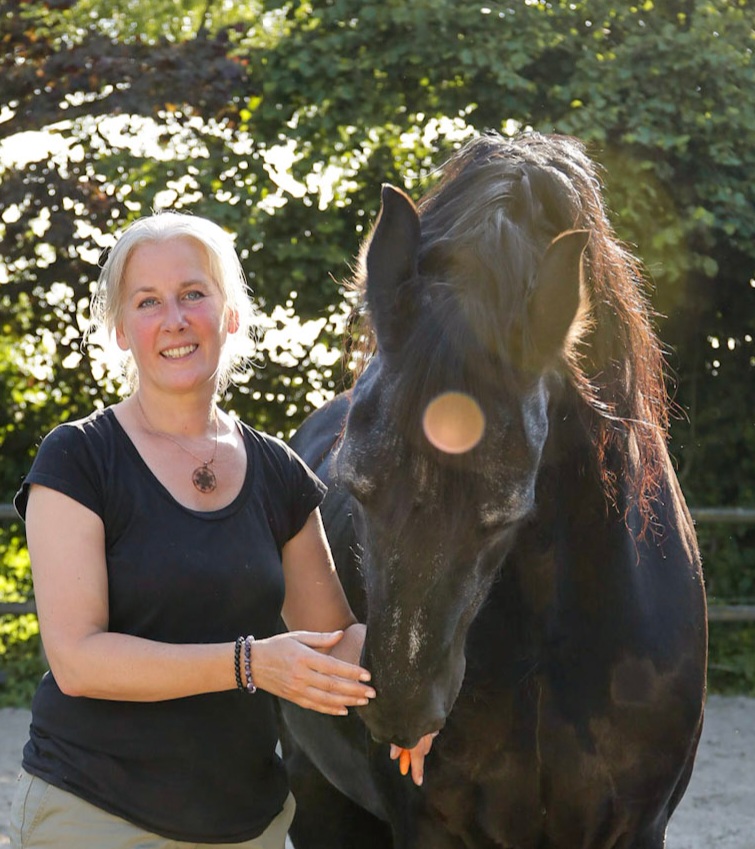
My horse Parsival has repeatedly reminded me that knowledge alone is not enough.
I have a strongly trained analytical mind.
As a lawyer, I learned to examine facts, identify contradictions, ask precise questions and consider different explanations.
My therapeutic training added anatomical knowledge, observation and practical methods.
All of this is valuable.
But Parsival taught me that the mind can also become so loud that it drowns out what I already perceive.
When I placed my first acupuncture needle on 26 January 2017, I received a message from him.
The original German wording was direct:
“Scheiß auf den Verstand.”
A gentler English translation might be:
“Forget the mind.”
He was not asking me to abandon reason.
He was not telling me to ignore my training.
He was reminding me not to let analysis silence intuition.
Knowledge and intuition do not need to compete.
They can work together.
The mind can provide structure.
Intuition can show us where to look.
Knowledge can help us assess what we perceive.
And perception can help us ask questions we might otherwise overlook.
The Horse in Front of Us
It is easy to approach a horse with a plan.
Today we will train this.
Today we will solve that.
Today the horse should respond in a particular way.
But the horse in front of us may not be the same horse we met yesterday.
Perhaps the night was restless.
Perhaps the weather changed.
Perhaps something happened within the herd.
Perhaps the horse feels uncomfortable in its body.
Perhaps we are the one who has changed.
Presence means meeting the horse that is actually there.
Not the horse from yesterday.
Not the horse we expected.
Not the horse we wish to have in that moment.
The real one.
The horse standing in front of us now.
Slowing Down Changes What We Can Perceive
When we hurry, our attention narrows.
We focus on the outcome.
We miss the small signs.
A change in breathing.
A shift in weight.
A tightening around the mouth.
A brief hesitation.
A softer eye.
A moment in which the horse is ready to connect.
When we slow down, more information becomes available.
Not because the horse suddenly begins communicating.
The horse was communicating all along.
We simply become quiet enough to notice.
This is one reason meditation and conscious breathing have become so important in my life.
They help me return to the present moment.
They do not make every thought disappear.
But they create more space between the thoughts.
And within that space, listening becomes possible.
Regulation Before Communication
When I enter a stable, I do not leave my inner state outside the door.
I bring it with me.
My breathing.
My thoughts.
My tension.
My expectations.
My entire day.
Before asking anything of a horse, it can therefore be helpful to arrive within ourselves first.
To feel our feet.
To notice our breath.
To relax the jaw and shoulders.
To become aware of the pace inside us.
Sometimes a few conscious breaths are enough to change the quality of an encounter.
The horse may not suddenly perform a spectacular movement.
Nothing dramatic may happen.
But the atmosphere changes.
The connection becomes clearer.
And both horse and human may feel a little safer.
Connection Does Not Require Constant Action
Many people feel that they always need to do something with their horse.
Train.
Improve.
Correct.
Exercise.
Achieve.
But connection can also grow in moments in which nothing is demanded.
Standing together.
Walking slowly.
Breathing.
Observing the herd.
Sharing a quiet moment without trying to turn it into a result.
These moments are not empty.
They are part of the relationship.
A horse does not need us to be constantly productive.
Sometimes our calm and undivided presence is already enough.
When the Horse Reflects Us
Horses are often described as mirrors.
I understand why.
Sometimes their reaction shows us something about our own state that we had not yet recognised.
A restless horse may make us aware of our own rushing.
A hesitant horse may reveal that our decision is not as clear as we thought.
A horse that keeps its distance may invite us to consider whether we are truly open or merely trying to appear friendly.
But I believe we should use the idea of mirroring carefully.
Not every emotion, symptom or behaviour of a horse belongs to the human.
A horse is an individual being with its own body, history, needs, experiences and environment.
The horse is not responsible for displaying all our unresolved issues.
And the human is not automatically to blame when a horse is unwell or distressed.
The question of resonance can be valuable.
But it should remain a question rather than becoming an accusation.
Perhaps the horse is reflecting something.
Perhaps it is expressing something entirely its own.
Perhaps both are true at the same time.
Careful observation helps us remain open to more than one possibility.
Trusting What Feels Coherent
Over the years, I have learned to pay attention when something does not feel coherent.
That does not mean acting on every passing feeling.
It means pausing.
Looking again.
Asking another question.
Checking whether the body, the circumstances and the facts support the impression.
My sensitivity allows me to notice subtle changes early.
My analytical mind helps me examine them.
This combination has become an important part of my work with animals and people.
I do not want to choose between intuition and reason.
I want both at the same table.
What Inner Stillness Really Means
Inner stillness is not the absence of thought.
It is not emotional perfection.
It is not a spiritual performance.
It is the ability to remain present while thoughts and emotions move through us.
It is the willingness to listen before reacting.
It is the courage to notice what is actually happening instead of immediately forcing the situation into our plan.
With horses, inner stillness creates room.
Room for the animal to respond.
Room for us to notice.
Room for a different solution.
Room for truthfulness.
And perhaps that is why horses have always felt so important to me.
They invite us to become more genuine.
They do not ask us to become flawless.
But they do ask us to become present.
The Lesson I Continue to Learn
I still have days when my mind is loud.
Days when I want an answer quickly.
Days when I enter the stable carrying too many thoughts.
Parsival continues to remind me.
Slow down.
Breathe.
Listen.
Do not let the plan become more important than the being in front of you.
Do not let knowledge become a wall between you and perception.
And do not confuse control with connection.
The lesson is simple.
Living it is a daily practice.
A quiet mind changes the way we move.
It changes the way we touch.
It changes the way we make decisions.
And it changes the way an animal experiences our presence.
Sometimes the most meaningful thing we can offer a horse is not another technique.
It is a human who is truly there.
With love,
Anke
Schreibe einen Kommentar